SUPPORT PENAJA

Showing posts with label FUYOO..ENGLISH CORNER. Show all posts

Friday, 17 February 2012

THE CONQUEST OF EVEREST


A CENTURY AFTER IT WAS SHOWN TO BE THE EARTH'S HIGHEST POINT, EVEREST WAS FINALLY CONQUERED, BY EDMUND HILLARY AND TENZING NORGAY


A survey carried out in 1852 showed Mount Everest to be the highest point on the surface of the earth, and over the next 101 year expeditions from several countries tried unsuccessfully to climb this mighty peak, leading many to conclude that Everest was unconquerable.
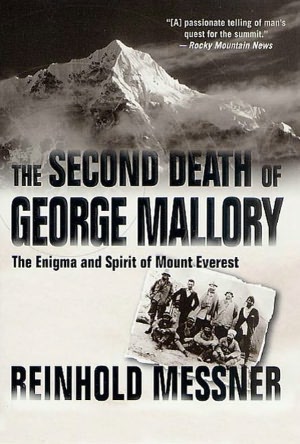
In 1924 George Mallory and Andrew Irvine climb above 28,000 feet / 8,534 m and then disappeared, rasing the possibility that they may have reach the summit and died on the decent, but still noone  knew     whether Everest could be climb. 


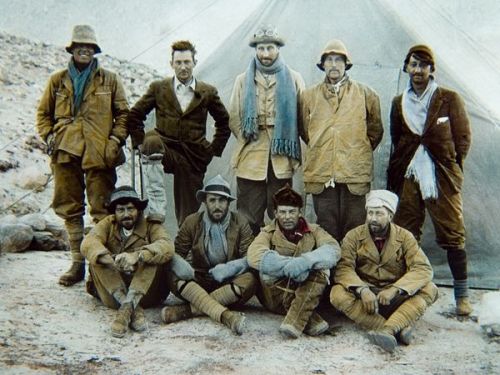
George Mallory and Andrew Irvine
The last photograph of George Mallory (left) and
Andrew 'Sandy' Irvine. Courtesy of Royal Geographical Society 
Then, at 11.30am on May 26, 1953, Edmund Hillary and Tenzing Norgay conquered " the unconquerable" and became the first human known to have stood on " the roof of the world


ON TOP OF THE WORLD


Expedition leader colonel John Hunt had decided to launch two assaults  on the summit. The first pair of climbers was driven back by lack of oxygen, and then Hillary and Norgay would given their chance of making history, carrying heavier, but longer - lasting, breathing equipment. 


Hours after living their highest camp, they reach what Hillary describe as " symmetrical, beautiful snow-corn summit,"  where they planted flag, Norgay buried offering to the Gods of mountain and Hillary left a crucifix given to hi by Hunt. The news reached Britain on the eve of Queen Elizabeth II's coronation and The Evening News reported, " Today, while million of flags deck Britain, the loneliest Reunion Jack in the world flies from its highest peak

          This photo is of Tenzing as a young man
British mountain climber George Mallory 
on the Aiguille Verte in France in 1909.
.


BEATLEMANIA


BEATLEMANIA STARTED WITH TELEVISION APPEARANCE ON SUNDAY NIGHT AT THE LONDON PALLADIUM AND SOON BECAME A GLOBAL PHENOMENON.

The Beatles already had a huge following in the clubs of Liverpool and Hamburg by the time they signed a recording contract in 1962, and within a year of releasing their first single, " Love Me Do," that club following had been turned into a national phenomenon. On October 13, 1963, after three No. 1 singles, the Beatles topped the bill on the British television show Sunday Night at the London Palladium and drew and estimated 15 million viewer for a performance that was almost completely drowned out by the screams of the live audience - a hysterical and soon typical reaction that the media named Beatlemania.

The symptoms of Beatlemania, which mainly affected teenage girls, were a tendency to block streets by gathering in large crowds near theaters, television studios, or airports; a high incidence of screaming, crying, an hysterical wailing; uncontrollable clutching pf the face and hair; fainting; and occasional loss of bladder control.

BEATLEMANIA CROSSES THE ATLANTIC

If the Beatles had ever worried about "breaking" the American market, those fears were laid to rest when, with " I Want to Hold Your Hand" at No.1 om the U.S. charts, they arrived in New York on February 7, 1964, to be greeted by the now familiar sight of some 3,000 screaming, faiting girls. They made three consecutive appearances on The Ed Sullivan Show,  the first of which was watched by record 73 million people, and two months later " Can;t Buy Me Love became the first single to simultaneously top the UK and U.S. charts. Beatlemania had crossed the Atlantic, and with the phenomenon also begining to affect Australia and Europe, It soon took over the world.

Wednesday, 15 February 2012

DISNEYLAND OPENS


WALT DISNEY REALIZED OWN DREAM, AS WELL AS THOSE OF MILLION OF CHILDREN, WHEN HE OPENED HIS DISNEYLAND THEME PARK IN JULY 1955.

During his childhood Walt Disney's strict Presbyteriab parents were continually telling him that play and leisure were a waste of time, but in adulthood he made childhood fantasy his way of life. During the 1930's. after establishing a Hollywood cartoon studio and making his break with Steamboat Willie, Disney began to consider setting up an eight-acre "magical park" next to his Burbank studio for the use of his employees and their families. World War II prevented him from doing so, and by the time peace came, his plan had gtown enormously. He now saw it as his life's mission to create a theme fantasy land "where the parents and the children could have fun together," although he had difficulty realizing his mission because, he said, " I could never convince the financiers that Disneyland was feasible, because dream offer too little collateral.


THE DREAM BECOME REALITY

Having eventually raised the necessary $17 million, Disney bought a 160-acre site in Anaheim, California, and construction began in July 1954, just a year before opening, on the five individually themed zones that would make up the Magic Kingdom of Disneyland: Main Street U.S.A., which Disney said, " turned back the clock to the days of grandfather youth" ; Frontier land, celebrating " the pioneering spirit of our forefathers" ;  Adventureland, "an exotic tropical place" ; Tomorrowland, looking at " the marvels of the future ", and Fantasyland, complete with castle and fantasy village, where "classic stories of everyone's youth become realities for youngsters - of all ages -  to participate in".
With the Magic Kingdom attracting more than 5 million visitors a year, Disney proved that dreams can creatre collateral, and while it was criticizer for its sanitized view of life, Disneyland proved so successful that the Disney Cooperation went on to open three more theme parks, in Florida (1971), Tokyo (1983) and Paris (1992)

THE DEATH OF MARILYN MONROE


MARILYN MONROE, DESCRIBED BY THE TIMES NEWSPAPERS AS " NOT SO MUCH A HOLLYWOOD LEGEND AS THE HOLLYWOOD LEGEND," DIED  ON AUGUST 5, 1962.

In July 1962 Marilyn Monroe was sacked from the set of the film Something's Got to Give  for persistent absence. To the public she was still Hollywood's greatest star and one of the world's most desirable and highly paid women, but in private, things had fallen apart - her marriage third husband, Arthur Miller, had ended in divorce; her latest film, The Misfits, had flopped at the box office ( though it achieved cult after her death); and now she had lost the opportunity to show that The Misfits was a temporary aberration. The trajectory that had taken Monroe from poor orphan to "the most potent star attraction in the American cinema" had passed its zenith, and the plunge back down to Earth was a rapid one.


THE OVERDOSE

At about 8.00 pm on August 4, Marilyn's friend Peter Lawford spoke to her on the telephone and was so worried by her tone that he asked her lawyer, Mickey Rudin, to check on her. Rudin phoned at 9.30, but Marilyn's housekeeper, Eunice Murray, told him that everything was fine ; Marilyn was resting in her room. In fact, she was probably already dying. 
At about 3.00am. Murray woke sensing something wrong and noticed that Monroe's light was still on. The bedroom door was locked, so Murray went outside, reached through the window grille to part the curtains, 
and saw Marilyn lying face down on the bed with one hand on the telephone and a near-empty bottle of sleeping pills beside her. Murray had already phoned Marilyn's psychiatrist,  Ralph Greenson, who arrived at 3.40 am, closely followed by her doctor, Dr. Engelberg, who pronounce Monroe dead at the sence. Conspiracy theories have persisted ever since that her apparent suicide was in fact murder, with Marilyn's well-known sleeping problems providing the perfect cover for anyone intent on ending her life

THE FIRST JET AIRLINES


THE WORLD'S FIRST JET AIRLINES WAS THE DE HAVILLAND COMET, WHICH HERALDED THE ARRIVAL OF A NEW SOCIAL PHENOMENON- THE "JET SET"


During the 1950s jet air travel became the ultimate luxury for those who could afford it. Many flight times were helved compared with those made by conventional aircraft, but journeys were still slow by modern standards - in May 1952 the world's first jet passenger service, a British Overseas Airways Corporation (BOAC) flight from London to Johannesburg, made five stop on the 18 1/2 hour journey to South Africa.

The BOAC sevice was launched using the aircraft with which Britain hoped to gain world leadership in passenger transport design : the de Havilland Comet. Developed since 1944 as a closely guarded industrial secrete, the comet made its maiden flight in July 1949 and went into freight service in January 1952 befora taking its place as the world's first jet airliner with the flight to Johannesburg on May that year.

THE FIGHT FOR SUPREMACY

The Comet may have been the first jet airline into service, but it was not the world leader for long. Three months after de Havilland's pride and joy flew to South Africa, U.S manufacturer Boeing began developing a military and civil transport aircraft, which in 1955 went into passenger service as the Boeing 707. Meanwhile , technical problem had led to the Comet's being grounded and redesigned, but even the much improved Comet 4 could not compete with the more technologically advanced 707, which outperformed it in pods beneath the wings, the Boeing also stole the British dream of setting the pattern for left behind by the 707 : On October 4, 1958, it was used to inaugurate the world's first transatlantic jet passenger service, 22 days ahead of the Boeing.

PEARL HARBOR


THE SURPRISE RAID BY JAPAN ON THE U.S. NAVAL BASE AT PEARL HARBOR KILLED 2.403 PEOPLE AND PRECIPITATED THE ENTRY OF AMERICA INTO WORLD WAR II.


THROUGHOUT THE 1930s Japanese expansionist policy in East Asia stained that nation's diplomatic relation with the rest of the world. As late as July 1940, Japan professed the intention to avoid a conflict with with the United States, but on October 11, 1941, Admiral Isoroku Yamamoto was given approval for his plan to attack the U.S Pacific Fleet at anchor in Pearl Harbor, Hawaii. Japan continued ostensibly negotiating with the United States until November 29, but by then the Japanese fleet had already left harbor under radio silence to take up position for the attack.


"TORA! TORA! TORA!"
On December 2 the Japanese attack fleet was put on action stations with the order Niitaka Yama Ni Nabare ("Climb Mount Niitaka"), and by dawn on December 7 the ships were in position 250 miles north of Hawaii. At 6.00am the first wave of 183 bombers, torpedo planes and fighter escort took off from Japanese aircraft carrier. at 7.48am the commander of the first wave signaled To, To, To (" Fight, Fight, Fight") and them the infamous Tora! Tora! Tora! ( " Tiger! Tiger! Tigr!") to indicate that they had caught the Americans unawares. Meanwhile, a second wave 134 Japanese bombers and 36 fighter escorts had taken off from the carriers, arriving at Pearl Harbor at 8.40am ti continue the destruction.


THE UNITED STATE ENTERS WORLD WAR II
At 9.45am the last of Japanese planes returned to the carriers after a two-hour raid that had killed 2,403 American servicemen and civilians, and damaged or destroyed 19 ships and some 200 planes, at a cost of just 29 Japanese planes and 64 dead or missing servicemen. 
The previous day, U.S. president Franklin Roosevelt had appealed directly to Japan's emperor Hirohito to avoid war with the United State -  the following day Roosevelt asked congress for authorization to go to war against Japan. With the official declaration by Congress the war already raging in Europe, Africa, and Asia expanded to become a second world war in fact as well as in name


HIROSHIMA AND NAGASAKI


THE DROPPING OF ATOMIC BOMB ON HIROSHIMA AND NAGASAKI BROUGHT AN END TO WORLD WAR II, BUT AT A TERRIBLE PRICE TO HUMANITY.


On July 29, 1945, Japan rejected an ultimatum issued by the Allies to surrender unconditionally or suffer "complete destruction." This left two options : invade Japan or use the awesome power of what U.S president Harry S Truman described understandably as "a new weapon of unusual destructive force" -  the atomic bomb. U.S. military adviser considered that an invasion would incur some 1 million Allied casualties and untold civilian death, so Truman opted for what he considered the lesser of two evils, authorizing the immediate use of four atomic bombs. He also reiterated the call for surrender, warning the japanese og " a rain of ruin from the air, the like of which has never been seen on this earth."


LITTLE BOY AND FAT MAN


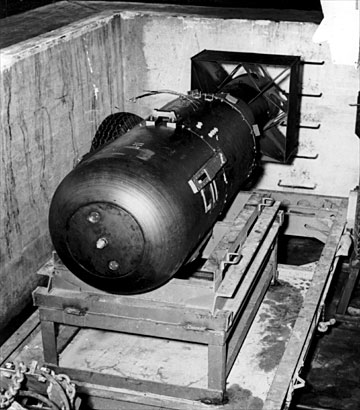
On August 6 Operation Centerboard began. A B-29 bomber name Enola Gay, after the mother of the pilot, Colonel Paul W. Tibbets, took off from the Mariana Islands, in the Pacific Ocean, for the city of Hiroshima, where bombardier Major Thomas Ferebee released an atomic bomb code-named Little Boy. The tail gunner, who witnessed the explosion from 10 miles away as Enola Gay returned to base, voiced a thought that would be echoed around the globe:  " My God. What have we done?" The city was vaporized, nearly 1000,000 people were killed instantly, and up to 250,00 died of burns and radiation sickness, some of them years later.

Japanese surrendering on the USS Missouri
Still Japanese would not surrender, and on August 9 a second atomic bomb, code-named Fat Man, was dropped on the port Nagasaki, wreaking similar destruction but with fewer casualties. The following days, Emperor Hirohito announced that Japan would surrender conditionally, thereby preventing the United State from dropping the remaining two atomic bombs, which had been scheduled for August 14 and 16.


THE BLITZ


To Germans, blitzkrieg means " lightning war", but for Britain the 'Blitz" means eight long, slow months of devastating air raids.


THE FIRST COUNTRY TO EXPERIENCE BLITZKRIEG WAS POLAND when the German navy and air force began bombarding that country's major cities and ports and the swift, mobile armored units of the German army swept across the border. Compared with the trenches of World War 1, " lightning war" was an apt term for this new form of warfare. In Britain the RAF prevented the process of blitzkrieg from progressing beyond the stage of aerial bombardment, and " lightning war" turned into a slow war of attrition as the Luftwaffe attempted to bomb the country into submission.


THE BLITZ ON LONDON


Air raids on London began on "Black Saturday," September 7, 1940, and continued every night for more than two month with the exception of November 2, when bad weather grounded the Luftwaffe. However, the Blitz on London did not have the desired effect. It was a tactical error it that it allowed the RAF to regroup and ultimately win the Battle of Britain, and it was a psychological error in that did not break the morale of Londoners, but instead made them more defiant and more supportive of prime Minister Winston Churchill's dogged determination to fight on at all costs.


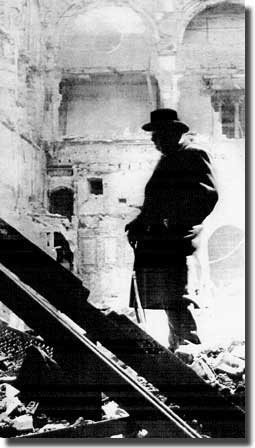
Churchill inspects Bomb
damage to House of Commons
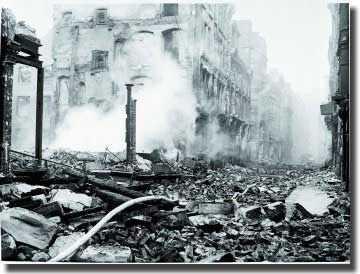
London during the Blitz (1941)


Bomb Damage in London December 1940


THE BLITZ ON BRITAIN


The Blitz was soon extended to most of Britain. When it became clear the capital would not be bombed into submission, the Luftwaffe began systematically bombing other industrial cities important to the war effort, as well as continuing intermittent raids on London. 
After the almost total destruction of Coventry on November 14, 1940, the Germans coined a new verb: Coventrisieren,   "to annihilate or raze to the ground." Over the coming months many other cities would be Coventrized, including Belfast, Birmingham, Bristol, Glasgow, Hull, Liverpool, Manchester, Plymouth, Portsmouth, Sheffield and Southampton. Some 42,000 people were killed and countless homes and historic buildings destroyed in the eight months of the Blitz, but Britain did not buckle, and reprieve eventually came with Hitler's decision to turn instead on his former ally, the USSR